Migrating Whales
They-say wind farms pose no threat to migrating whales, but millions are being spent on developingmitigation methods or strategies to combat a threat "they-say" doesn’t exist.
A recent study found that more than 86% of possible offshore wind farm impacts on ecosystems are still unknown. Most papers we read openly conceade that there are masive knowledge gaps in research on offshore wind-farms. This page identifies the main threats to whales posed by offshore Renewable Energy Zones. The inapropriate sites chosen are a major concern for all of the coastal communities, who are directly impacted by so-called wind-farms.
Whales of Australia
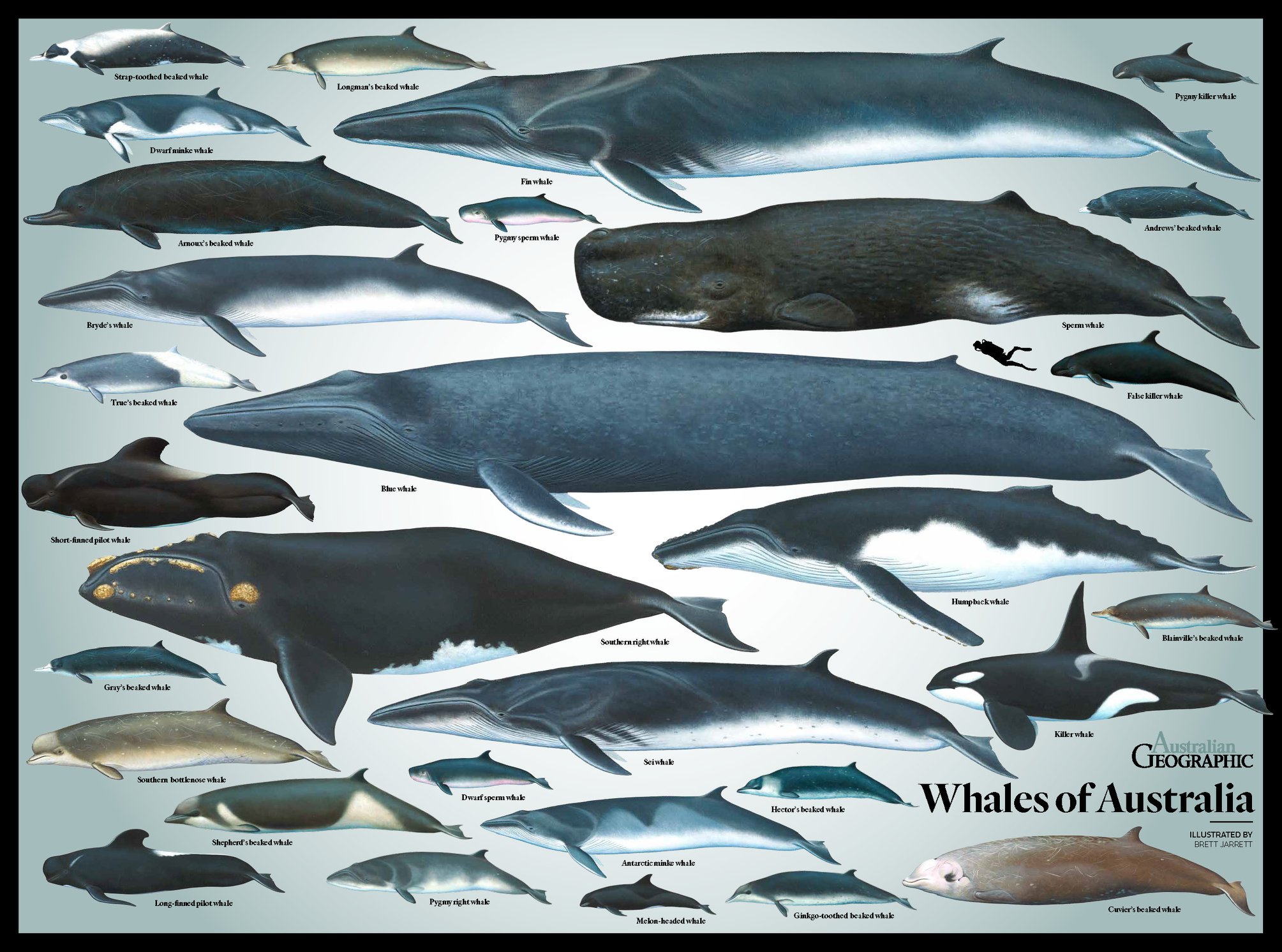
At least 45 species of whales, dolphins and porpoises are found in Australian waters including 10 large whales, 20 smaller whales, 14 dolphins and one porpoise. Four whale species are currently listed as nationally threatened under the EPBC Act:1. Blue Whale (endangered)
2. Southern Right Whale (endangered)
3. Sei Whale (vulnerable)
4. Fin Whale (vulnerable):
Humpback Whale
Australian humpback whales were removed from the threatened species list in February 2022. This was due to a significant population recovery from near extinction, following the ban on commercial whaling. Their population has grown from as few as 1,500 to an estimated 40,000 individuals in Australian waters.Southern Right Whale
The southern right whale (Eubalaena australis) is a large baleen whale known for its V-shaped blow and distinctive white callosities on its head.Once hunted to the brink of extinction the species is now protected globally and is slowly recovering. Though certain populations, such as the one in south-eastern Australia remain endangered.
Whales of Australia
Bass Strait
Bass Strait serves as a crucial migratory corridor and feeding/calving area for several whale species. Notably the Southern Right Whale, the Antarctic and Pygmy Blue Whale, who use the sheltered coastal waters from May to November. Other species include the Minke Whale, Killer Whale and beaked whales that are frequently sighted in the Bass Strait, along with various dolphin species.Humpback Whale
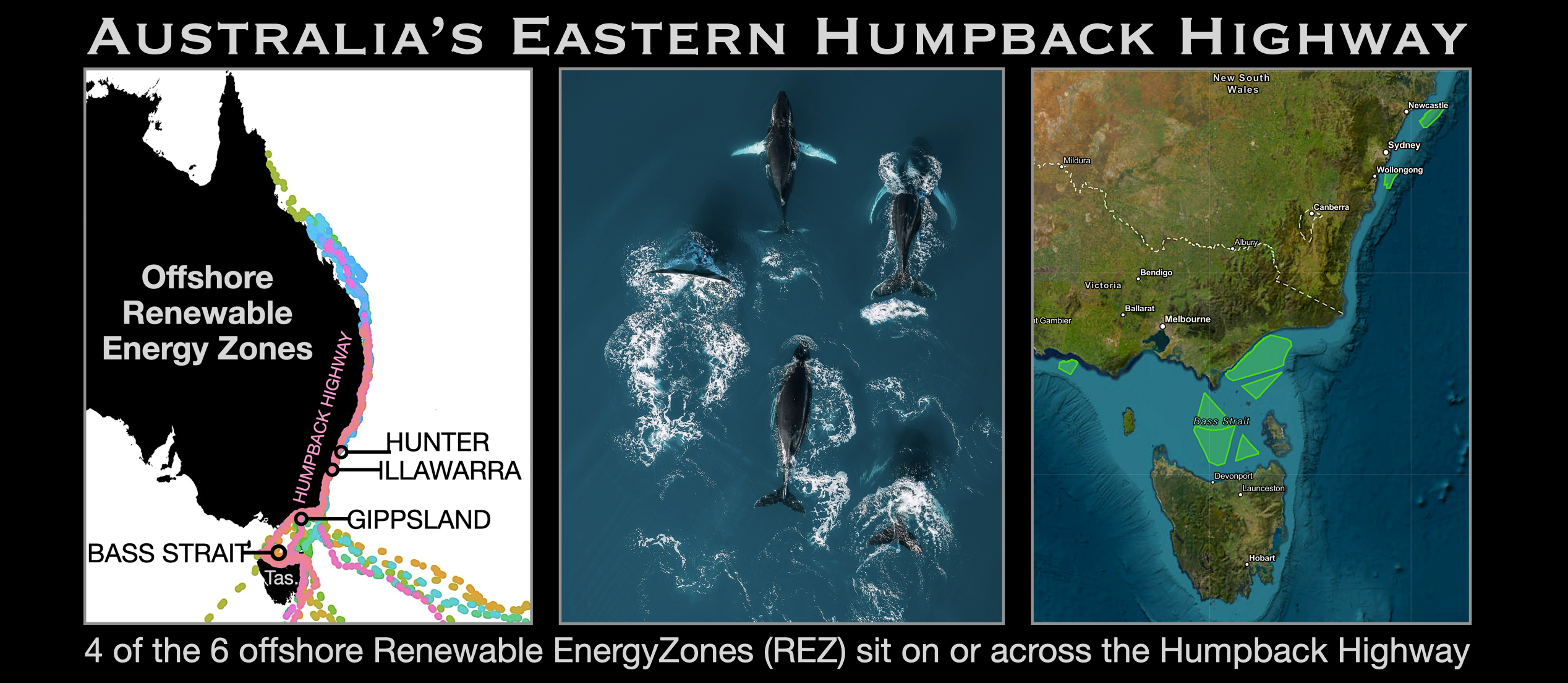
Bass Strait, which includes the Gippsland Renewable Energy Zone, is a significant migratory corridor for humpbacks traveling from Antarctic feeding grounds to warmer northern Australian breeding waters. Recent research, including a report by the The Dolphin Research Institute, indicates the area holds greater ecological importance than previously thought, with validated observations of feeding humpbacks and the presence of young calves.As shown in the image right, whales are spending up to a month in bass Strait loitering and foraging (red dots) before making the long trip back to their summer feeding grounds near Antarctica.
Blue Whale
Bass Strait is also an important migratory area for blue whales, with both pygmy blue whales and Antarctic blue whales using the waters. They are drawn to the area due to its rich feeding grounds, particularly the Bonney Upwelling off the coast of Victoria and South Australia.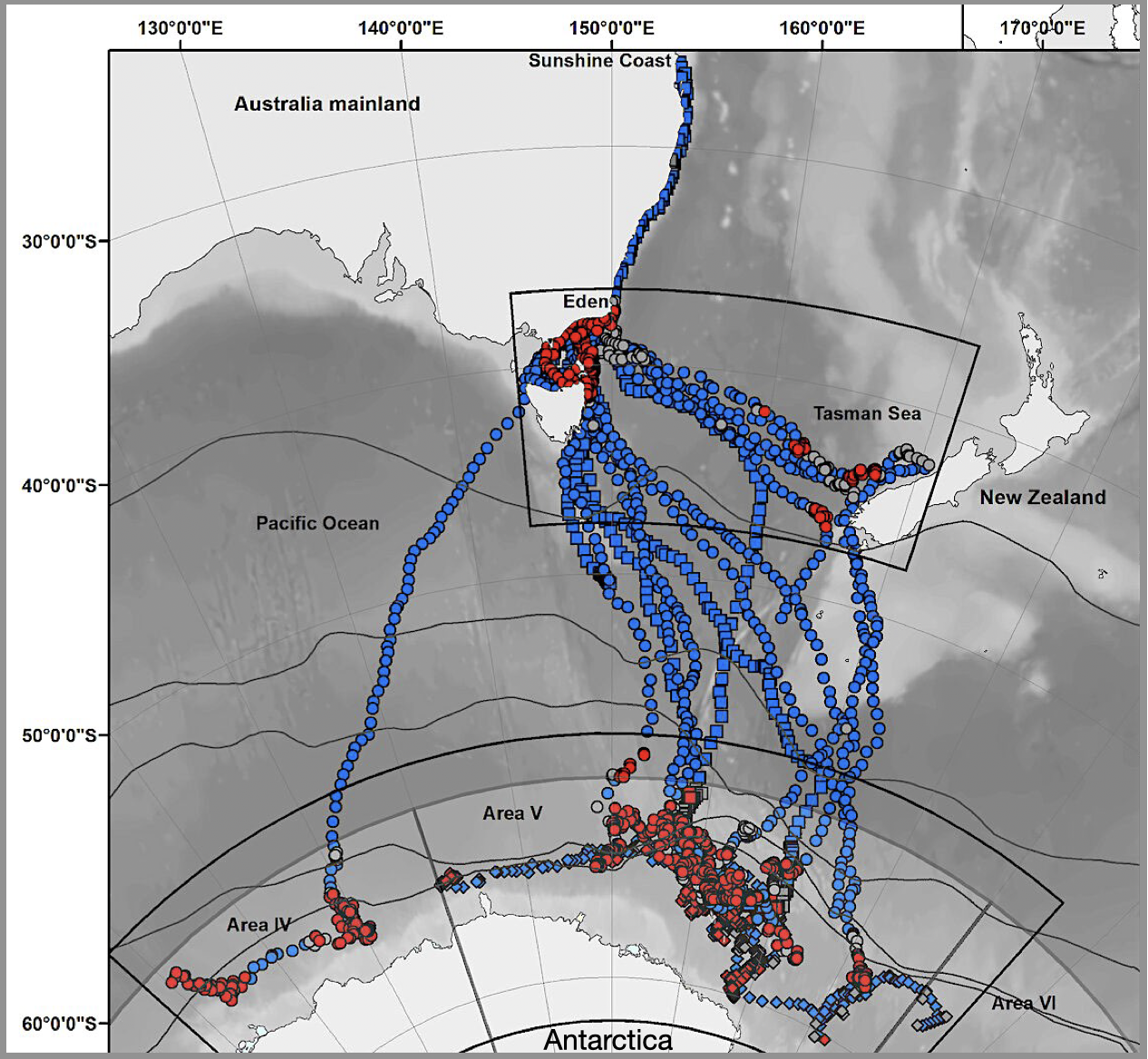
Humpback Highway (LINK)
Dots represent migration pathways of satellite-tagged whales off the eastern coast of Australia.
Dots represent migration pathways of satellite-tagged whales off the eastern coast of Australia.
Wind Turbines
Fixed-to-bottom
Fixed foundations are the lessor of two evils, only because they lack the massive mooring systems and dynamic power cables of floating wind turbines. There is a long list of adverse impacts on biodiversety, which is mostly during construction and decomisioning. A recent study has found that foundations of offshore wind turbines have a larger impact on the marine environment than previously thought. They change mixing of the water far beyond their own location that can have an adverse impact on the entire marine ecosystem.Floating Turbines
Floating wind turbines require huge mooring and anchorage systems that can affect the integrity of the seafloors. Marine mammals (whales) may collide or can get tangled up in the mooring system and power cables. Also, the noise caused by the wind farms accumulates with other sounds from human activities, which can negatively impact on the behaviour of marine mammals. Floating platforms are also attracting invasive species, or opportunist species that can alter the balance of marine biodiversity.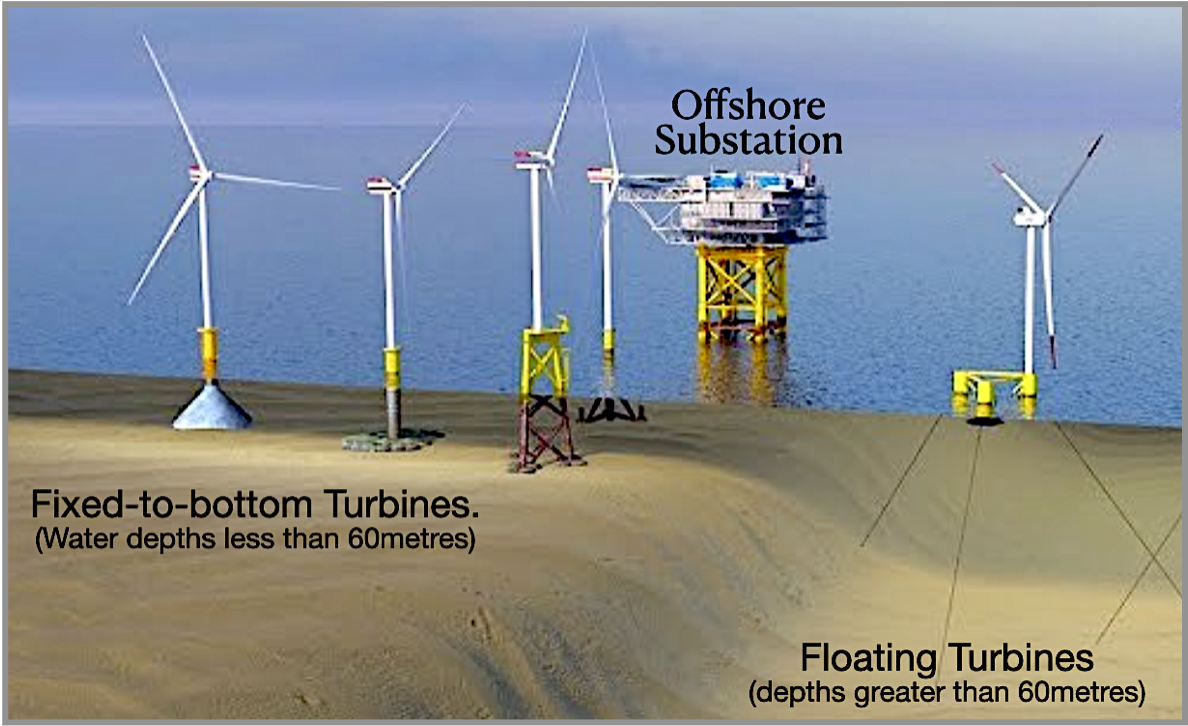
Types of Turbines and Substation
Offshore Substations
Offshore substations are a critical component of large offshore wind farms, collecting the electricity generated by the turbines. They converted the power from the array from AC to DC power to minimize energy loss in transmission to shore via export subsea cables. Where it is converted back into AC at a land based substation for inclusion into the main grid.Noise Polution
Constrution Noise
During construction, intense and impulsive noise from piling can cause physical harm or stress to marine animals, including whales and dolphins.Noise During Operation
Turbines generate continuous low-frequency noise that can mask biological sounds and cause behavioral changes in marine mammals, fish and invertebrates. Leading to disrupting sensory functions that causes physiological damage and altering their behavior.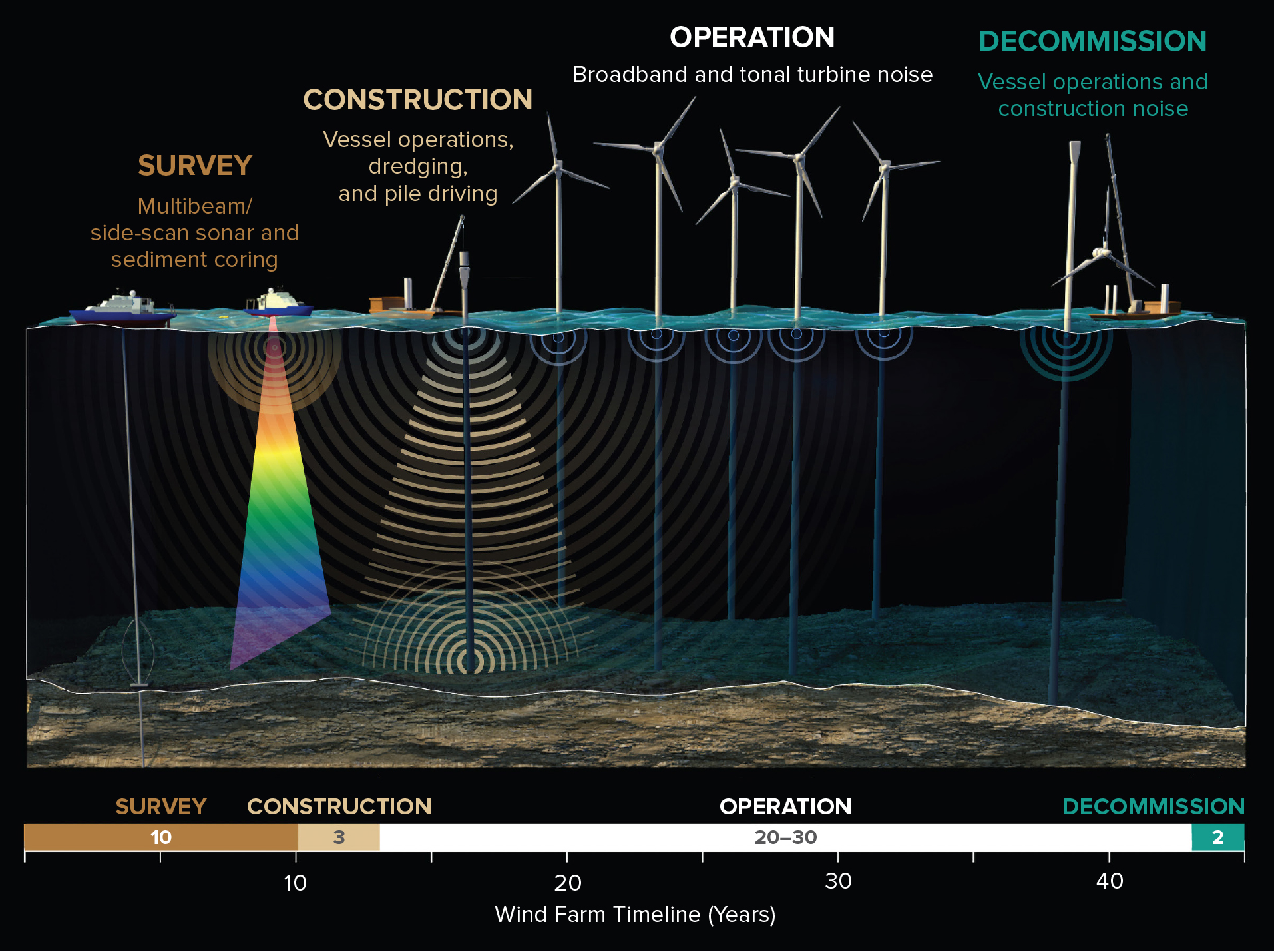
Stages of Noise Polution
Barrier Effect
Concerns have been raised that large whales may collide with and or become entangled in lines and cables from renewable energy installations, causing injury or death. Building 1,666 turbines in the Gippsland Renewable Energy Zone that covers anarea of 1.5 million hectares would create a massive barrier in the humpback highway.Primary Entanglement
This Primary entanglement is the direct entanglement of a marine animal in the below-surface infrastructure of a wind turbine, such as the cables or mooring lines. The risk is considered low because of size of mooring lines and power cables, but the risk remains. .Secondery Entanglement
Secondary entanglement is a risk for marine life, where an animal becomes entangled in marine debris, like lost fishing gear and other rubish that has become snagged on a floating turbines mooring lines and or power cables.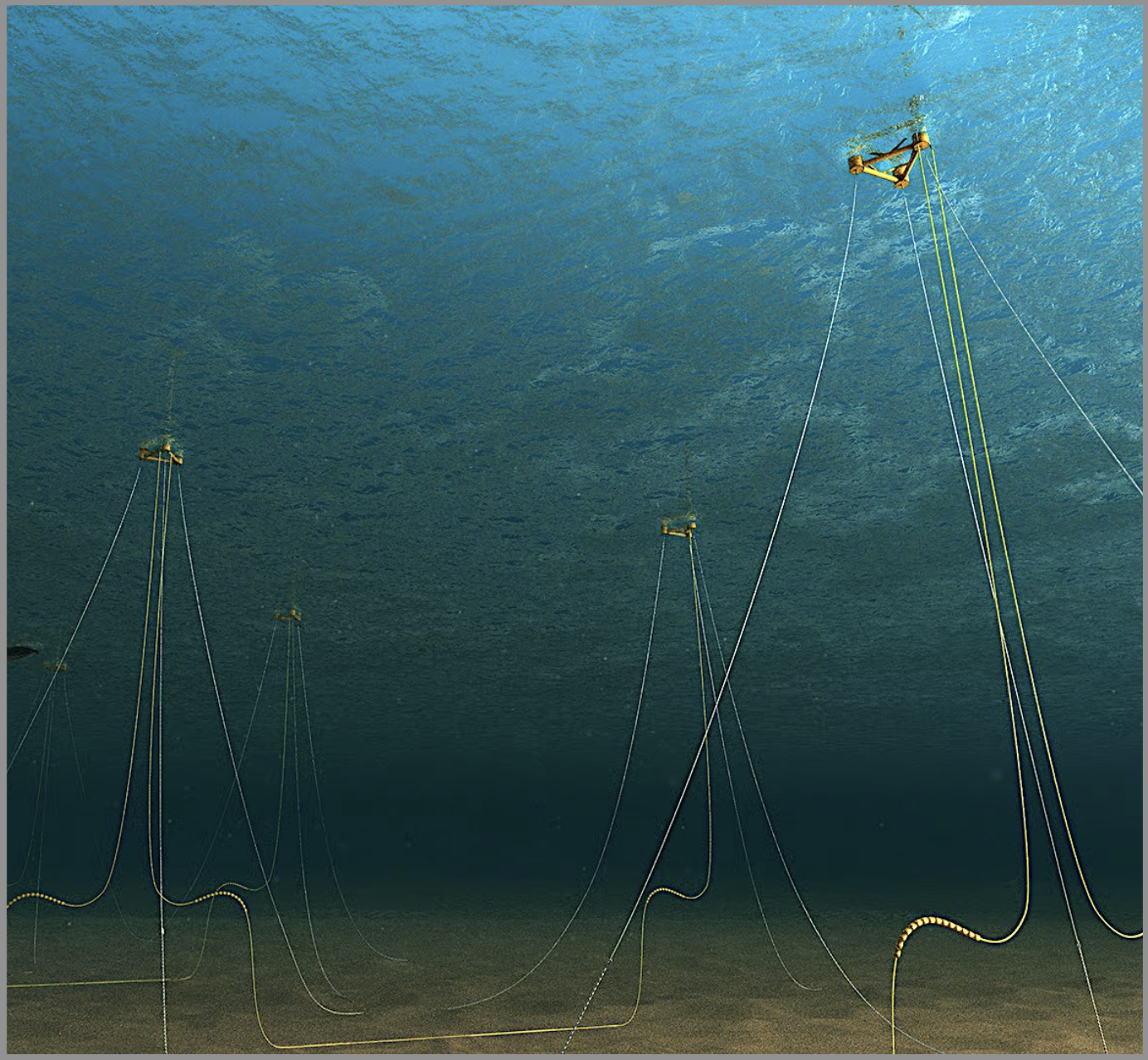
Image Caption 5-A
Collision
During a storm or in a big swell floating wind turbines can rise and fall in quick sucession, which can cause the mooring lines and power cables to whip around wildly in all directions. The turbine on its own weighs up to 10,000tons. So anthything struck by the barnicle encrusted mooring lines and power cables, would suffer blunt force trauma or cause skin abrasians that could lead to death.Electro Magnetic Field
EMF
Offshore wind farms generate electromagnetic fields (EMFs) primarily from the subsea power cables that connect all of turbines in the array and export the electricity to shore. These fields are a concern for certain marine species that use natural EMFs for navigation, orientation and predation.Electric vs. Magnetic Fields
The metallic sheathing on the power cables typically blocks the electric field (E-field) from reaching the external environment, but the magnetic field (B-field) is not as easily contained and emanates into the surrounding water. The changing magnetic field induces a weak electric field in the surrounding seawater. The commulative effect of hundreds of of kilometres of power cables configured in a grid pattern would masivle increase the magnetic field.Figure. a
This image shows three alternative foundations fo fixed-to-bottom wind turbine. Studies have shown some minor and species-specific behavioral changes, such as attraction to or avoidance of cables, altered swimming speed and changes in foraging behavior.More research, especially long-term studies and those involving next-generation floating wind farms is needed to fully understand potential cumulative and long-term effects on the marine ecosystem.
Figure. b
All six of Australia's declared offshore Renewable Energy Zones will require some if not all floating wind turbines.1.BUNBURY 50%.
2. SOUTHERN OCEAN 50%.
3. BASS STRAIT 90%.
4. GIPPSLAND 30%.
5. ILLAWARRA 100%.
6. HUNTER 100%.
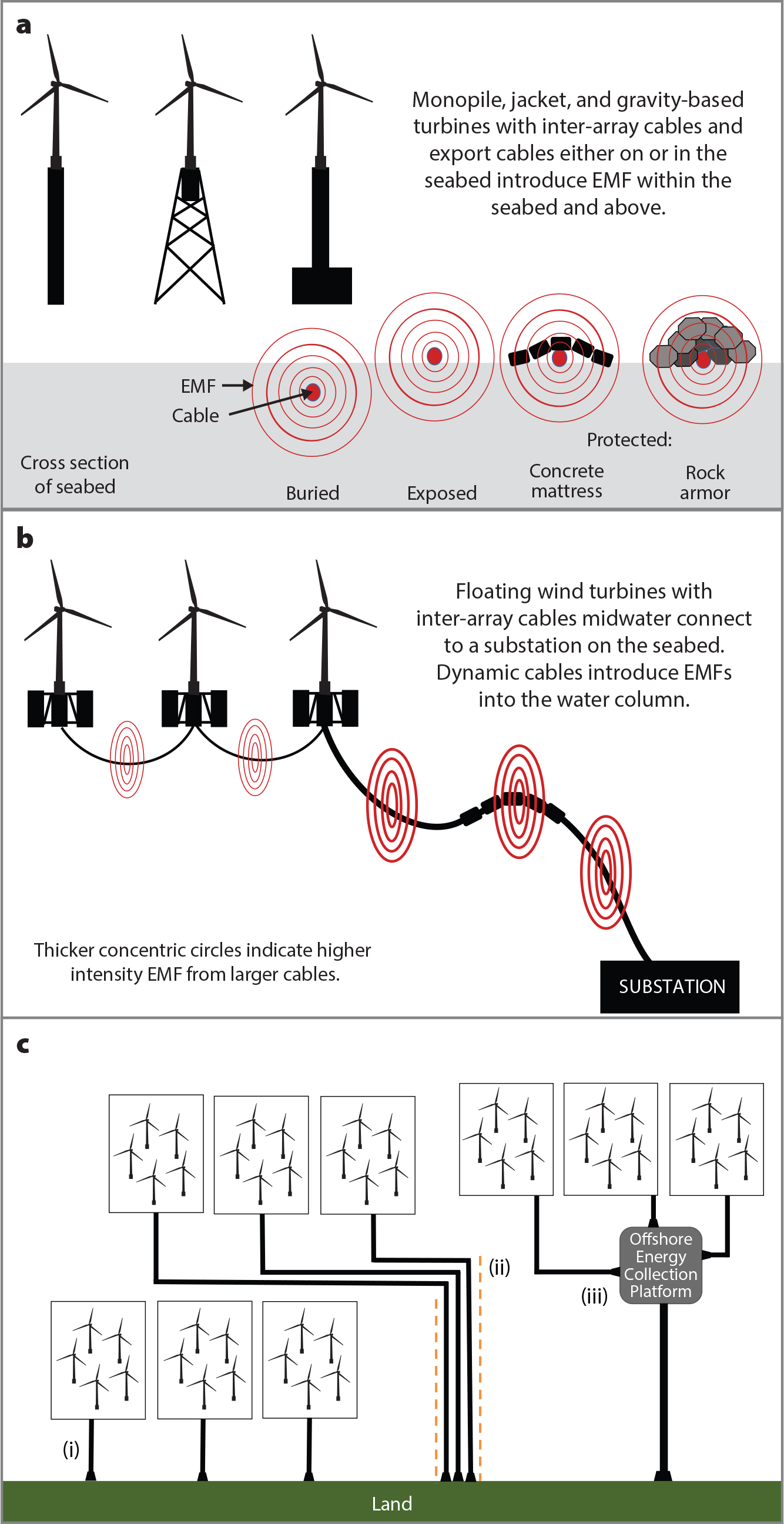
Sources of EMF
Figure. c
Cable route configuration options as arrays increase in coastal waters include;(i) simple individual exports from each array.
(ii) multiple cables that may be in corridors.
(iii) offshore collection platforms that employ higher capacity export cables.
All types of offshore wind-farms share a common feature, which is the inter-array power cables link individual turbines to each other and an offshore substation, forming the internal electrical network of a wind farm. These cables are a critical component for transmitting the generated power to shore.
North Sea
The image below clearly shows that the North Sea is not in a whale migration corridore. The green shaded area are satelite tracked whales. Which explains why there are no scientific studies on interaction between whales and wind turbines.Fixed-to-Bottom Turbines
There are more than 4,000 fixed wind turbines in the north sea.Floating Turbines
There are just 25 floating turbines in Europe, which is an emerging technology thats never been deployed on a commercial scale. If we let it happen Australia could be the worlds first deployment of lage scale floating turbines. Note; A fifth floating wind farm was commisioned this year (2025), the Provence Grand Large project in France. It features three Siemens Gamesa 8MW wind turbines. Which brings the grand total to 28, floating wind turbines.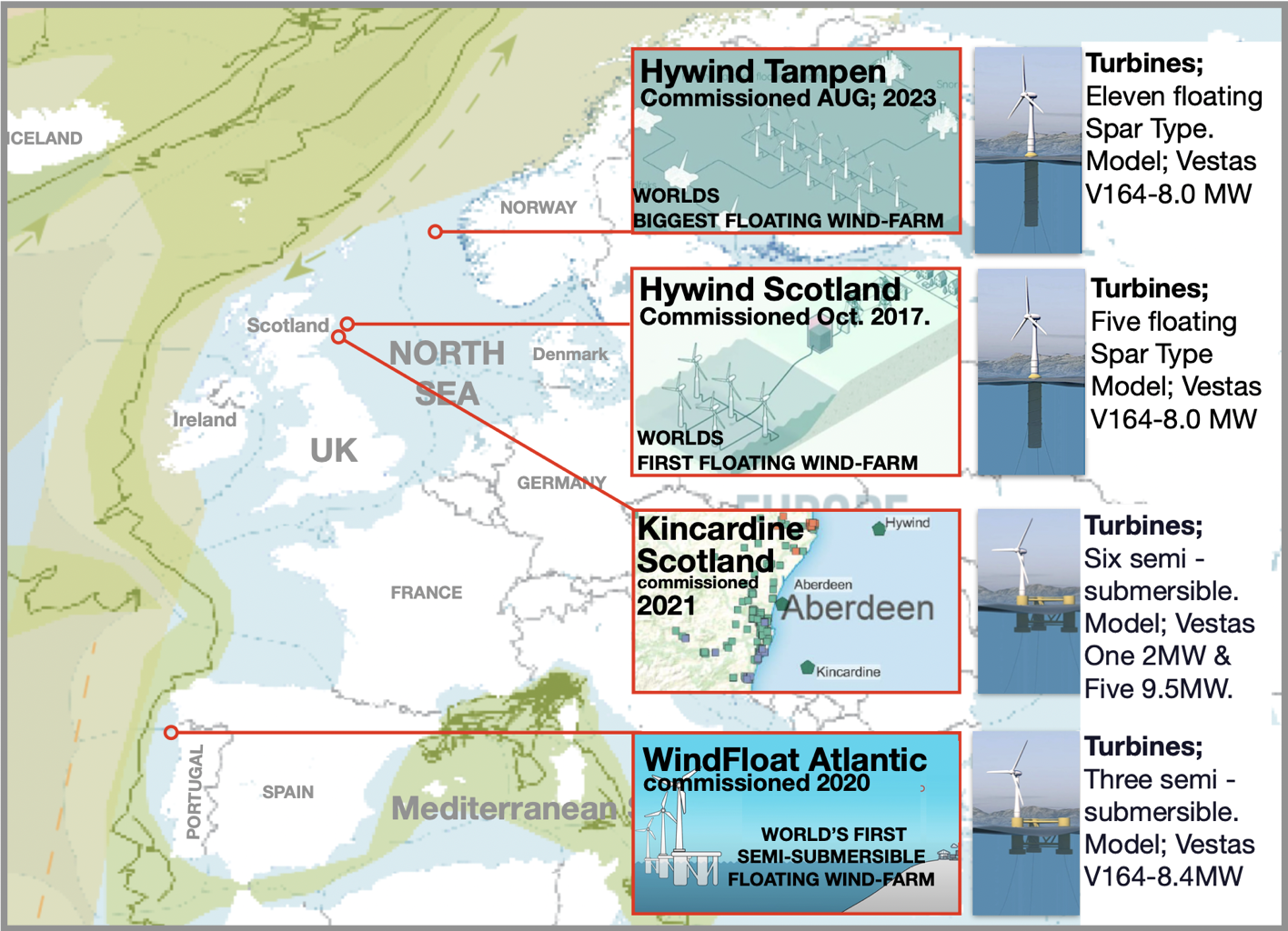
Floating Wind Farms vs. Whale Migration
US Dead Whale Crisis
The dead whale crisis remains a contesious issue on America's east coast and its the worlds first deployment of offshore wind farms in a "whale migration corridore", which is also a critical habitat for breeding and feeding of the endagered North Atlantic Right Whales. Since the first large scale wind farm was only recently compleated in the US, all of the controversy regarding whale deaths over the last decade or so, could be atribute to preliminery surveying work and seismic mapping of The New York/New Jersey Bight.Nantucket Sound
America's first large-scale offshore wind (Vineyard Wind 1) is near Massachusetts with its 62 turbines and Located just 15 miles south of Nantucket. Cape Wind was a previously proposed project in Nantucket Sound that was ultimately canceled.Gulf of Maine
The Maine lobster fisherman have done an amazing job in opposing the threat posed by offshore wind farms to their industry and the endangered North Atlantic Right Whale. The gulf is a deep-water-site that would require floating turbines. Due to a sucesful campaing lead by the lobster fisherman, the proposed site was reduced in size by around 80%.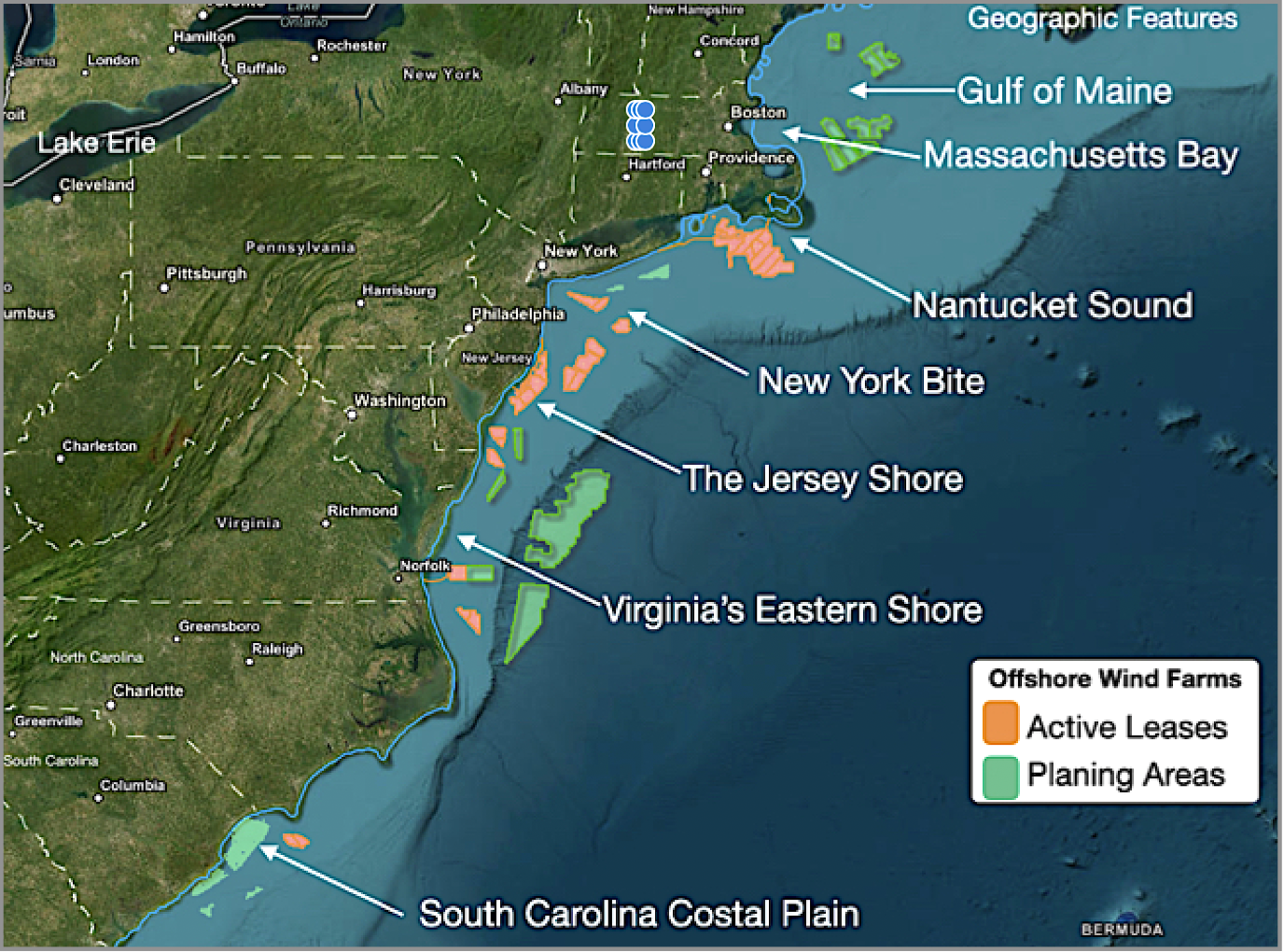
Image Caption 8-A
Inapropriate Site Selection
Inappropriate site selection for offshore wind farms typically involves locations that conflict with environmental protection areas, navigation corridors, existing subsea infrastructure, areas of high social/visual impact or those with unsuitable technical conditions.The Victorian National Parks Assosian advocates for a strong framework to guide development, identify “no-go” zones to protect marine parks sensitive areas and avoid or minimize impacts on biodiversity.
They go on to say "Current lack of planning of the marine environment is not setting Australia’s renewable energy transition up as a responsible one".
Whale Migration Corridores
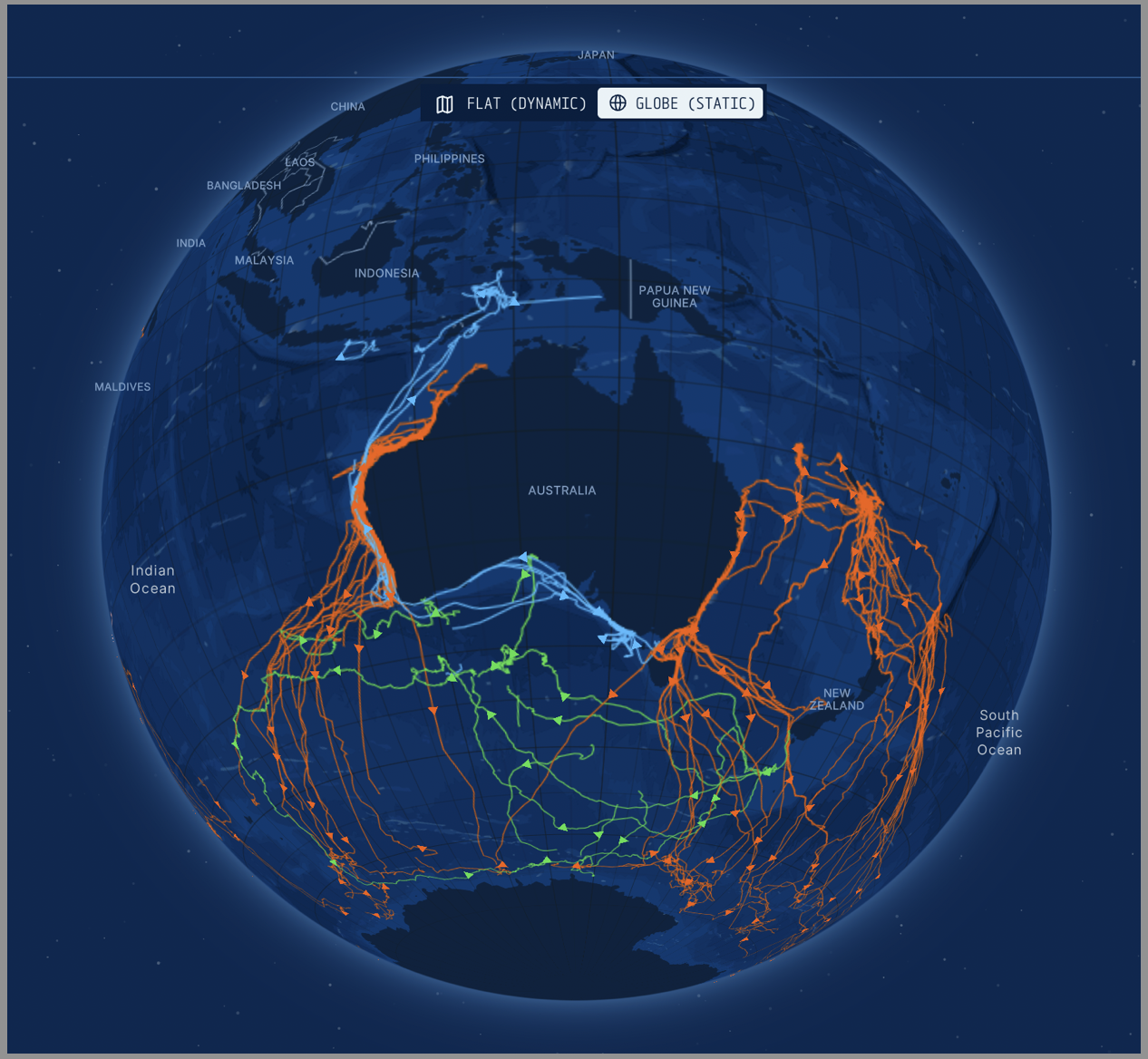
Australia truly is the lucky country, we have two HUMPBACK HIGHWAYS. Which are on the west and east coast of our amazing island continent. Which can be seen in the image right with the orange coloured satelite tracking lines of humpback whales.Note the high density of movements in Bass Strait and the Gippsland coast.