Auction
THE CLOCK IS TICKING
Victoria's Offshore Wind Auction — The Announcement Is Only the Beginning
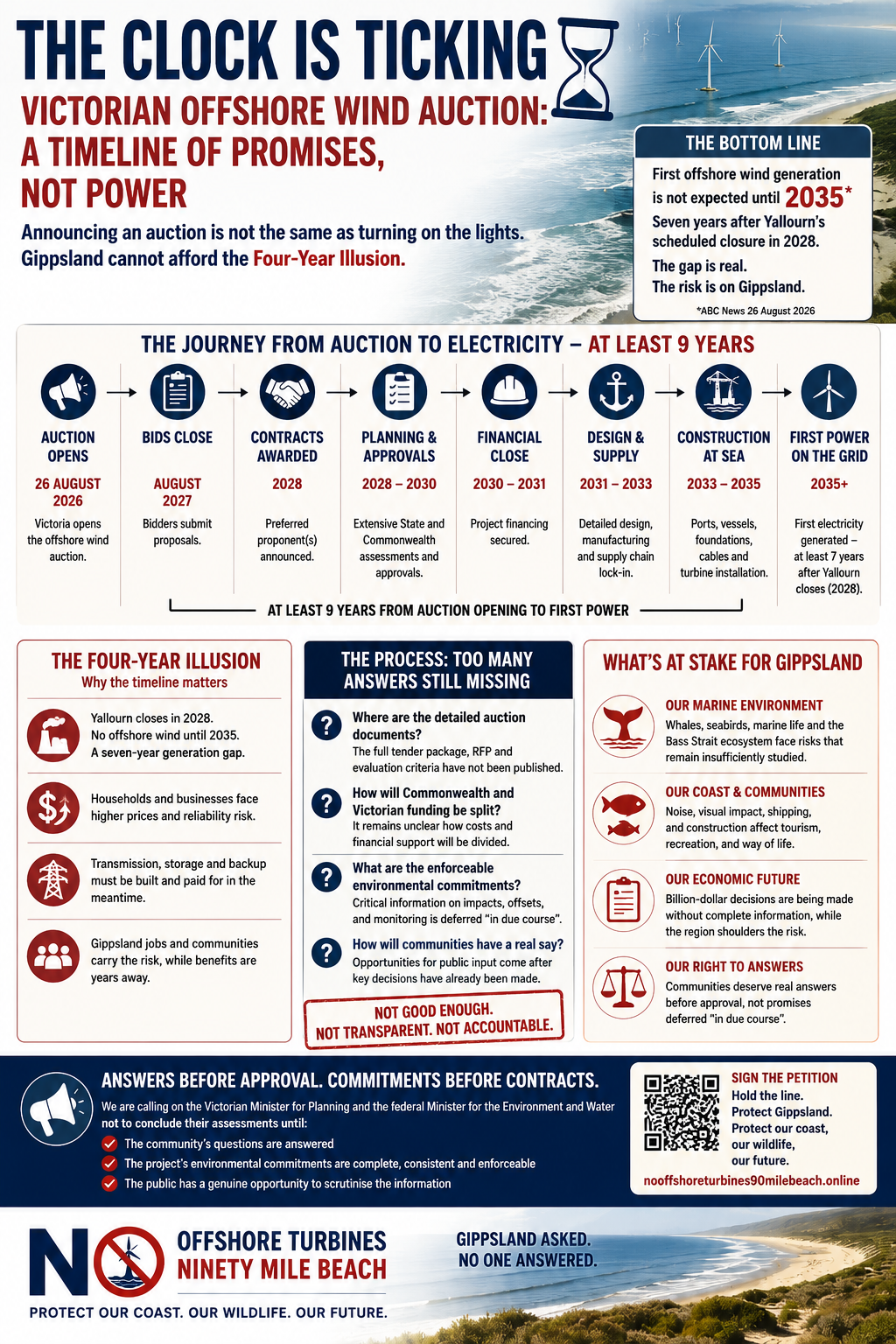
On 26 August 2026, the Victorian Government opened Australia's first offshore wind auction, seeking projects capable of supplying 2 gigawatts of offshore wind generation. It sounds like a major step forward. But an auction does not generate electricity.It begins another process.
Bids remain open until August 2027. Contracts are expected to be awarded in 2028. And despite Victoria's legislated target of at least 2 GW of offshore wind by 2032, the first offshore wind generation is now reported as not being expected until 2035. That distinction matters.
The Four-Year Illusion
Public discussion about the energy transition often concentrates on dates when coal-fired power stations are scheduled to close and dates attached to renewable-energy targets. Between those dates, however, lies the difficult part. Projects must obtain approvals, reach financial close, complete engineering and procurement, establish supply chains, secure specialist vessels and port facilities, construct transmission infrastructure, install foundations, cables and turbines, commission the project and finally deliver electricity into the grid.None of those things occurs when an auction is announced.
Yallourn Power Station is scheduled to close in 2028. Yet the first offshore wind generation is now reported as not being expected until 2035.
That leaves an obvious question:
**What happens in between?**
It is what we have called **The Four-Year Illusion** — the danger of confusing government targets and project announcements with electricity actually being available when it is needed. The auction also raises questions. The Victorian Government says successful projects will receive government support and that bidders will be assessed on value for money and their ability to deliver benefits to local communities. Those are important objectives.But communities are entitled to understand much more.
What financial commitments will ultimately be made by taxpayers and electricity consumers?
How will risks be divided between government and developers?
What happens if construction costs rise, projects are delayed or proponents withdraw?
How will environmental obligations be incorporated into contractual arrangements?
And how will communities affected by the enormous onshore and offshore infrastructure required to deliver these projects participate in decisions made along the way?
These are not arguments for or against offshore wind. They are questions about **energy security, public expenditure, environmental responsibility and accountable government.
The clock is ticking
Victoria's offshore wind auction should therefore be viewed for what it is: an important milestone, but only the beginning of a much longer journey. Between an auction announcement and electricity flowing into Victorian homes lies years of assessment, financing, engineering and construction. The people of Gippsland deserve to know how that journey will be managed, what it will cost, what risks it creates and who ultimately carries those risks. Announcements are easy to make. Infrastructure is much harder to build.And electricity cannot be supplied by a target written on a calendar.